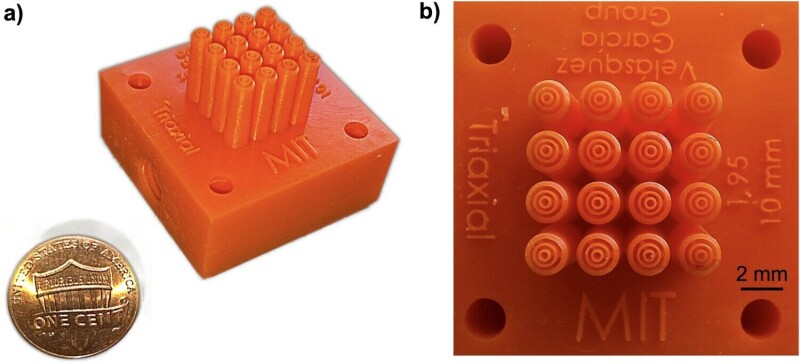
MIT Researchers 3D Print Electrospray Nozzles for Drug Delivery and Tissue Regeneration
MIT researchers have developed a method to 3D print specialized electrospray nozzles, traditionally requiring expensive cleanroom facilities. This advancement aims to simplify the production of particles for drug delivery and materials for tissue regeneration, potentially making these sophisticated applications more accessible and scalable.
Key points
- MIT researchers have successfully 3D printed electrospray nozzles, typically made in high-cost cleanrooms.
- These nozzles are crucial for atomizing liquids into very fine droplets, used in mass spectrometry and space propulsion.
- The new technique simplifies the fabrication of arrays of tiny, triaxial emitters.
- This innovation could lower costs and improve scalability for applications like triple-layer drug-delivery particles and tissue regeneration materials.
- The research aims to overcome limitations in producing precise, uniform, and low-cost miniaturized emitters.
A team at the Massachusetts Institute of Technology (MIT) has devised a novel way to fabricate electrospray nozzles using a standard 3D resin printer, bypassing the need for expensive cleanroom environments.
Electrospraying is a technique that utilizes an electric field to atomize liquids through tiny nozzles, creating droplets far smaller than those produced by conventional methods. These nozzles are fundamental components in a variety of advanced applications, ranging from ionizing liquids for mass spectrometry to enabling space propulsion systems. Historically, the precise fabrication required for these miniaturized emitters has been a significant cost barrier, limiting the scalability and accessibility of electrospray technology.
The MIT researchers, led by principal research scientist Dr. Luis Fernando Velásquez-García, detailed their work on creating arrays of triaxial electrospray emitters. Their advancement focuses on overcoming challenges in producing high-precision, uniform, and cost-effective miniaturized emitters in parallel. This breakthrough has direct implications for the production of triple-layer drug-delivery particles and materials used in tissue regeneration, potentially making these sophisticated medical and biotechnological processes more feasible and widespread.
Sources
The WireByte editorial team synthesises technology news from multiple primary sources, verifies the facts, and links every source. Articles are produced with AI assistance and reviewed under our editorial policy.