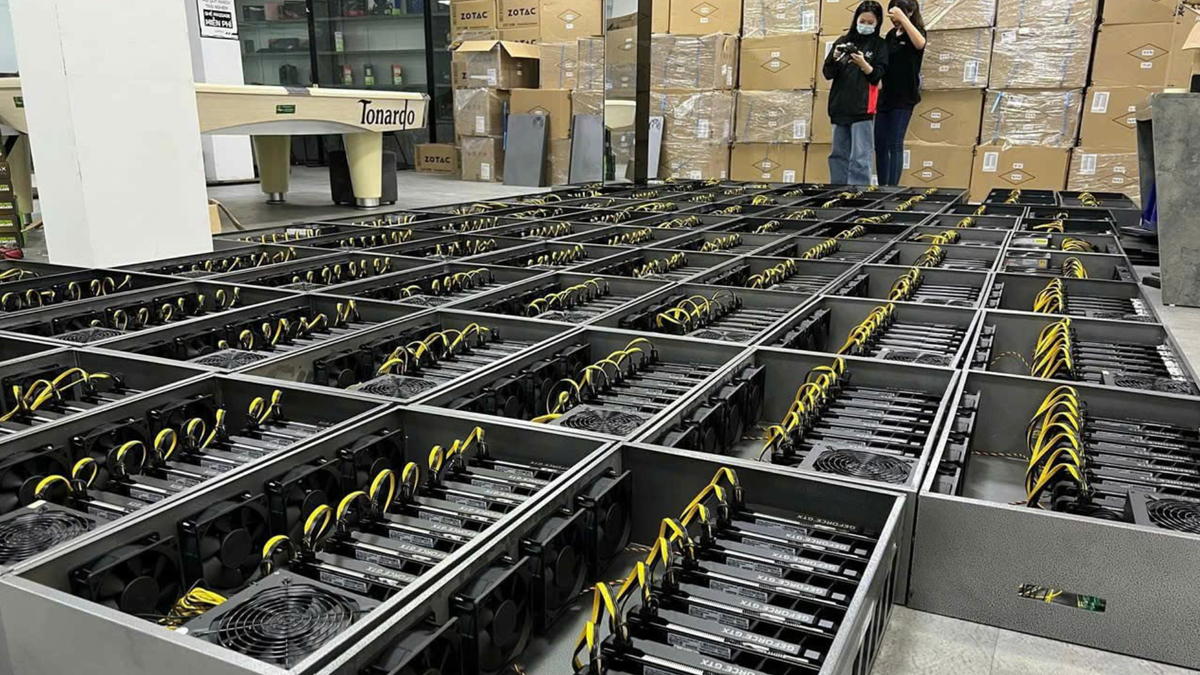
Study Alleges Crypto Network Burns 112MW on 'Zero Useful AI Computation'
A recent study alleges the Pearl Layer-1 blockchain, marketed for AI computation, consumes 112 megawatts across 320,000 high-end GPUs for 'zero useful AI computation'. Researchers claim the network performs random matrix math, not genuine AI work. This activity, which caused a 38% jump in GPU rental costs, raises questions about 'Proof-of-Useful-Work' systems and GPU resource use.
Key points
- A research preprint alleges that Pearl, a Layer-1 blockchain promoting itself for useful AI computation, is instead performing 'zero useful AI computation'.
- The study estimates Pearl's network utilizes the equivalent of approximately 320,000 RTX 3090-class GPUs, drawing an estimated 112 megawatts of power.
- Researchers assert that Pearl's mining protocol, called cuPOW, verifies random matrix multiplications rather than confirming actual AI training or inference workloads.
- The increased demand from Pearl mining reportedly led to a roughly 38% surge in budget GPU rental prices on the vast.ai marketplace since its software went public in May.
- This finding prompts scrutiny regarding the efficacy of 'Proof-of-Useful-Work' systems and their impact on valuable GPU resources intended for genuine AI development.
A recent research preprint has raised significant questions regarding the operational claims of Pearl, a Layer-1 blockchain network. Pearl has been marketed as a platform that transforms cryptocurrency mining into beneficial artificial intelligence computation. However, the study, titled 'The Usefulness Gap in Proof-of-Useful-Work,' purports that the network delivers 'zero useful AI computation'.
The report details that Pearl’s operations involve an estimated 320,000 GPUs, comparable to NVIDIA's high-end RTX 3090 class, consuming roughly 112 megawatts of power. Instead of engaging in genuine AI inference or training, the researchers claim Pearl's system, using a protocol named cuPOW, primarily processes random integer matrix multiplications. While these calculations structurally resemble the arithmetic foundational to neural networks, the study suggests there is no verification that the work originates from actual AI workloads. The protocol merely confirms the correct execution of these matrix operations.
The alleged mining activities by Pearl have also reportedly impacted the market for GPU rentals. Following the public release of Pearl's mining software in May, the study observed an approximate 38% increase in budget GPU rental prices on the vast.ai platform. Concurrently, the utilization rate for these rented GPUs surged from 57% to 94%, indicating a substantial redirection of computational resources towards the Pearl network.
These findings prompt a critical examination of 'Proof-of-Useful-Work' frameworks within the cryptocurrency landscape. They highlight a potential discrepancy between stated objectives and actual computational utility, raising concerns about the efficient allocation of potent hardware resources that are increasingly vital for legitimate AI research and development globally.
Sources
The WireByte editorial team synthesises technology news from multiple primary sources, verifies the facts, and links every source. Articles are produced with AI assistance and reviewed under our editorial policy.